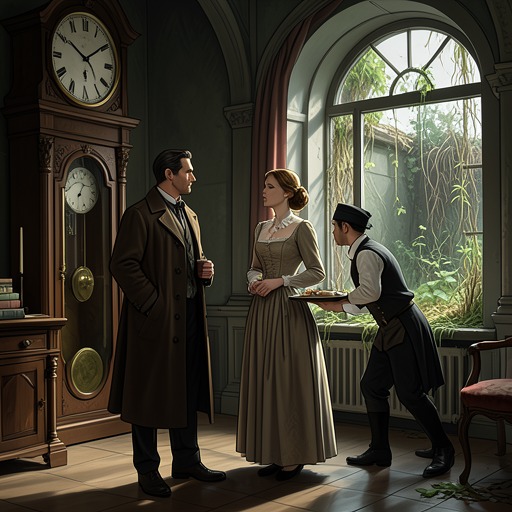
Netherfield party's departure
Just DesertsThe Netherfield party's departure is a decisive withdrawal rather than a simple journey to London. After the 1811 Meryton Assembly, Charles Bingley, Caroline Bingley, Louisa Hurst, and Mr. Hurst leave Netherfield Park with striking speed and little regard for the estate or the people connected to it. Their disappearance removes the principal social excitement from the neighborhood, but it also turns an apparently temporary absence into a public question about responsibility, sincerity, and who truly possesses authority at Netherfield.
Causes and Background
The departure follows a disastrous week at Longbourn and the tensions surrounding the Netherfield party. Charles Bingley had initially presented his stay as brief, saying that he would go to London for only three or four days before returning to spend the Christmas period at Netherfield Park. That expectation collapses almost immediately after he and Fitzwilliam Darcy depart. Caroline Bingley orders Netherfield Park closed, dismisses all but the core servants, and leaves for London with the Hursts. What had been framed as a short absence therefore becomes a withdrawal of the entire household.
Fitzwilliam Darcy learns of the closure in London when he encounters Charles Bingley in the entrance hall of their club. Charles Bingley is late for an appointment and can exchange only a few words, but he confirms that his sister has closed Netherfield Park and that the party will remain in London until at least the New Year. He then hurries away, leaving Fitzwilliam Darcy with unanswered questions about the estate’s arrangements. The scene makes the departure look less like a coherent decision than an evasion whose practical consequences have been left for others to manage.
What Happens
The Netherfield party leaves within two days of the ball. There are no courtesy calls, no explanations, and no instructions for the steward. Caroline Bingley’s decision to close the house removes the visible machinery of hospitality: servants are discharged, the estate is shut, and the household’s obligations disappear from public view. Netherfield Park remains as a substantial landed property, but its social and administrative presence is suddenly absent.
Jane Bennet receives a letter from Caroline Bingley on the day Caroline Bingley leaves Netherfield Park. The letter offers an explanation that does not actually explain the departure; instead, it sets out what Caroline Bingley wants to happen rather than acknowledging the reality of the abrupt abandonment. Its insincerity becomes clear to Jane Bennet, Elizabeth Bennet, and Mary Bennet, who count more than ten lies in the single letter. Jane Bennet, who would have been devastated by such a message two months earlier, can now read it with enough detachment to find it almost ridiculous.
The practical neglect is most clearly expressed through the tenants. While visiting Longbourn’s tenants in preparation for winter, Jane Bennet, Elizabeth Bennet, and Mary Bennet also check on the tenants nearest to Netherfield Park. They write several notes to the steward describing the problems they find, but the steward tells them that Charles Bingley left no instructions for dealing with the tenants. The departure thus transfers the burden of care from the estate’s master to his neighbors, who must respond to needs that the Netherfield household has ignored.
Consequences and Aftermath
The closure leaves Caroline Bingley and the Hursts in London and produces an angry reaction at Longbourn, especially from Mrs. Bennet. In Meryton, the absence becomes a source of jokes and speculation. More than a month after the departure, Charles Bingley has still not returned, and local sniggers ask who the real master of Netherfield has been. The question punctures the authority that Charles Bingley’s new title and estate are supposed to confer.
The event also changes the emotional meaning of Charles Bingley’s conduct for Jane Bennet. His earlier promise to return is measured against the speed with which the house is closed and the servants dismissed. Caroline Bingley’s letter cannot restore the impression of honesty, because its claims are contradicted by the visible facts. Jane Bennet’s response marks a movement from romantic disappointment toward clear judgment: what once might have broken her heart now confirms Charles Bingley’s capricious nature.
For Elizabeth Bennet, the departure removes one set of distractions from Hertfordshire but leaves behind the unresolved vexations of Longbourn and the Militia. For Fitzwilliam Darcy, it exposes a separate concern about Charles Bingley’s ability to manage a substantial estate. Fitzwilliam Darcy already doubts whether Charles Bingley understands the responsibilities of estate management; the closure, the lack of instructions, and the neglect of the tenants make that doubt concrete. The event therefore operates on two levels: socially, it ends Netherfield’s presence in the neighborhood; administratively, it reveals the gap between possessing landed status and fulfilling its obligations.
Narrative Significance
The Netherfield party's departure reverses the promise of stability associated with the country estate. Netherfield Park had seemed to offer renewed sociability, Jane Bennet’s possible happiness, and Charles Bingley’s establishment as a gentleman. Its rapid closure converts those possibilities into absence, rumor, and unpaid responsibility. The estate’s physical permanence contrasts with the household’s unreliability: the building remains, while the people who should animate and govern it vanish.
The departure also prepares a broader criticism of social privilege. Caroline Bingley wants the privileges of the landed gentry without the responsibilities, while Fitzwilliam Darcy suspects that Charles Bingley is not very different in practice. The abandoned tenants reveal the human cost of that distinction more sharply than conversation alone could do. The event is consequently not merely a romantic setback for Jane Bennet; it is a test of whether wealth, rank, and ownership entail obligations to dependants. Netherfield’s silence answers that test before its occupants return.